

November 25, 2025
Designer Fund
By any measure, Julie Zhuo had already made it. She’d helped define product design at Facebook while leading a design team of hundreds and written The Making of a Manager, now a modern classic on leadership. But what happens after you’ve achieved the thing you set out to do?
For Julie, the answer wasn’t to coast or climb higher. It was to begin again. After fourteen years at Facebook, she left to explore what it meant to build from the ground up. Today, she’s the co-founder of Sundial, a company developing tools that automate what the best analysts do so teams can make faster, smarter decisions.
Julie has always been a bridge between worlds: an engineer turned designer, a leader who still thinks like a craftsperson, a writer who turns experience into clarity. In this conversation, we explore how she made the leap from design leader to founder, what she had to unlearn along the way, and the advice she’d give designers thinking about starting something of their own.
What we cover:
How Julie recognized it was time to leave Facebook and start over after 14 years
Why she believes discomfort is a signal for growth, not a threat
Her practical framework for taking the first steps as a designer founder
The origins of Sundial and how early consulting work revealed the opportunity in data tooling
What she had to unlearn from Facebook, from delegation to consumer instincts
Why she and her co-founder chose to skip the CEO title
Why most designers mistake fear for preference when it comes to starting a company
Are you a designer building something new, or know someone who is?
We’re always looking for more designer founders to feature, invest in, or partner with. Recommend a designer founder
Choosing discomfort on purpose
When I first met Julie, we were both designers at Facebook, part of a small group trying to define what “product design” even meant at a company moving at breakneck speed. She’d trained as an engineer, so stepping into design came with a heavy dose of imposter syndrome. “I felt woefully underprepared for every new role and just had to learn through painful mistakes.”
But that discomfort was also what fueled her growth. “I started to realize that maybe you have to feel like an imposter to get that satisfaction of growth when you look back. So I started to choose discomfort on purpose.”
Over fourteen years, Julie grew from engineering intern to VP of Product Design, leading thousands. The first half was marked by self-doubt and stretch assignments; the second by frameworks and leadership. But after a while, the learning curve flattened. “There’s not much difference between managing 200 people and 400.” With a new baby and a sense that the job no longer stretched her, she decided to leave, choosing discomfort on her own terms this time.
“Ignore the whispers that beckon you towards the easy wins. Work hard for yourself, for the joy you feel when you’re one step closer to the person you’ve always wanted to be, whether it’s getting in the dirt to make things grow, getting in front of a crowd to speak your truth, or going out to find love behind all those brambles.”
From Julie’s essay, Our Soul Needs Proof of Work
Choosing who to build with
When Julie left Facebook, she wasn’t chasing a specific idea so much as a feeling of curiosity: “I still wanted to go out and explore, to understand myself and learn, what am I made of? What do I really love in this world?”
Early in that exploration, she reached out to Chandra Narayanan, Facebook’s former Head of Analytics and later Sequoia’s Chief Data Officer. “We have very different brains. But we share values, and I trust him completely.” What started as a casual check-in turned into a decision to work together long-term, possibly for decades, before they even knew what they would build.
They talked about what the next thirty years might look like if they built a life of work together: making products, yes, but also teaching, investing, and giving back. That long view created room to dream without pressure. When COVID hit the day after their first consulting project began, they spent the next year doing remote, fractional work for a handful of startups, helping with design, product, and strategy.
A pattern emerged across those projects. “A lot of these companies just didn’t have good data practices. They didn’t have the metrics or the observability. They didn’t really know what was going on.” One day, Chandra suggested, “Why don’t we build some tools to help automate that process for our companies?”
They began prototyping with a few contractors in India and found themselves completely absorbed. “We just got really into it. It was so fun that we decided to make it real.”
Building Sundial
Sundial’s mission is simple to say but hard to achieve: automate what great analysts do.
The idea grew from Julie and Chandra’s shared experience at Facebook, where disciplined use of data was core to how products were built and improved. At most companies, leaders want clarity and control but translating business questions into analytical answers is slow and human-intensive. “The way organizations solve that problem is by hiring specialists. But we kept asking, why can’t a product do that?”
Their goal with Sundial is to make software that feels like working with an exceptional analyst, not another dashboard. As Julie puts it, “We’re trying to productize Chandra’s brain.”
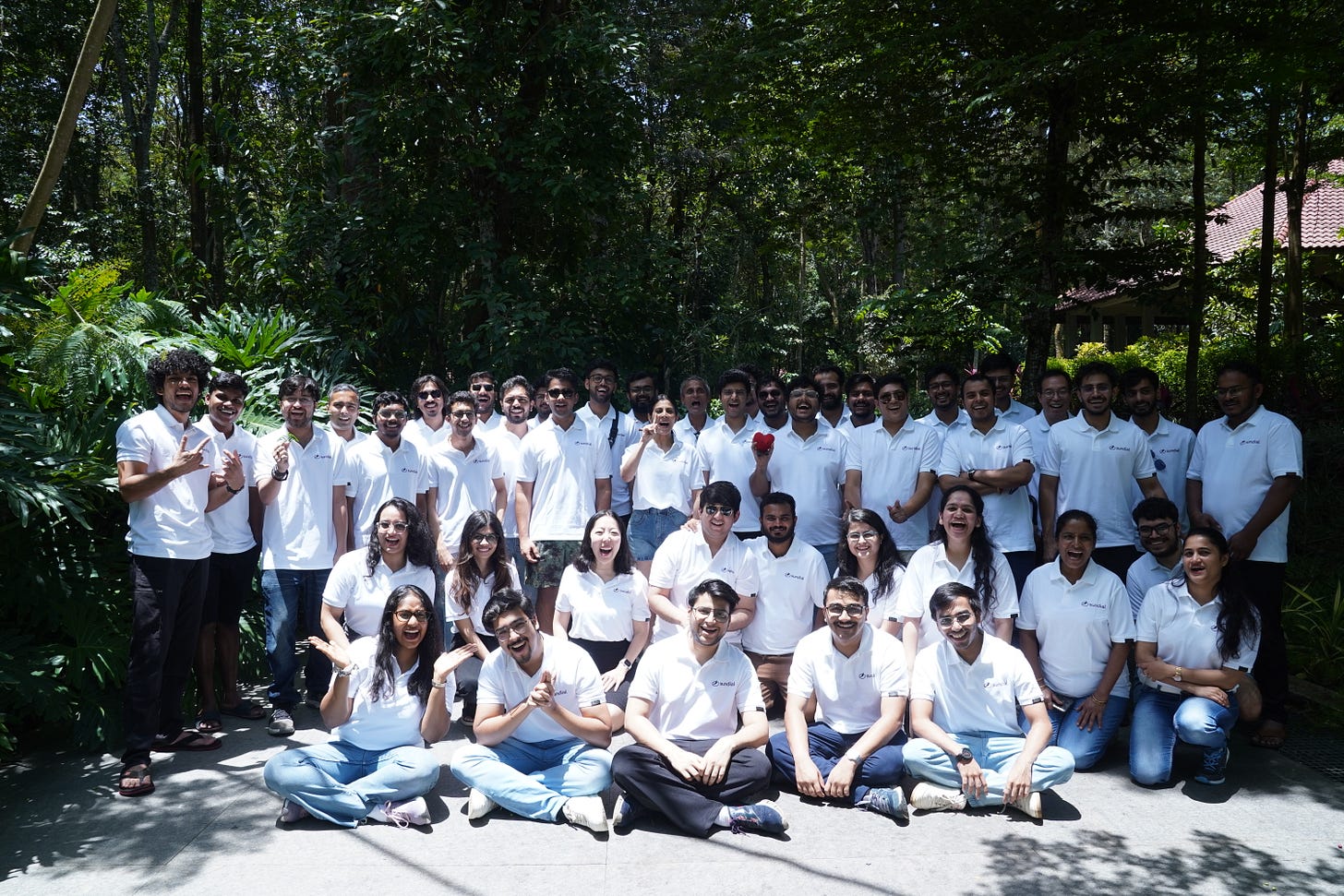
They hadn’t set out to start a venture-backed company, but the scope of the problem demanded it. The data tooling landscape was already crowded—“a hundred logos, and we’d heard of maybe ten”—yet their ambition was to build something foundational. Today, Sundial is a 50-person distributed team across the U.S. and India.
On titles and hierarchy
Julie and Chandra chose to call themselves co-founders rather than take on formal CEO titles. They didn’t want hierarchy to get in the way of how people showed up or spoke up, especially with a distributed team and many teammates in India, where companies often lean hierarchical. “Between us we know how we’d break ties. But we didn’t want that to bias information flow.” The title choice helps keeps things flat while leaving room for clarity when decisions need to be made.
What she had to unlearn from Facebook
Julie literally wrote the book on management. But starting Sundial meant trading scale for scrappiness and unlearning instincts that had been second nature after 14 years at Facebook.
1. Stop defaulting to delegation
At Facebook, Julie’s leverage came from delegation. As a VP overseeing hundreds of people, her job was to think in systems: defining direction, aligning teams, and trusting others to execute. Founding a 0→1 company was the opposite:
“I had to unlearn delegating as a primary lever and get back to rolling up my sleeves. I’d gotten really good at talking about things, writing docs about things, opining about things. I’d gotten out of practice at actually doing the thing myself.”
At Sundial, that meant re-immersing herself in the work: writing specs, defining product flows, doing sketches, coding prototypes. “When you think about what has to happen for an engineer to build something, someone has to redline it. Someone has to decide the thousands of micro-decisions, like is this spacing five pixels or seven?”
It was humbling to realize how much her subconscious habits still defaulted to management mode. “You can know something consciously and still act out of instinct. I worried about micromanaging for years as I learned to scale teams. Then I realized that in the 0-1 phase, you don’t even get the luxury of building a larger team if you don’t have a good initial product. That must be micromanaged.”
2. Consumer instincts don’t translate to B2B
Julie spent her career building consumer products where she was the user. You trust your instincts, you design for emotional resonance, and you believe the product should speak for itself. “That’s the muscle you build as a designer. You want the work to be self-evident.”
B2B, she learned, runs on a different logic. “When you’re selling to companies, you have to tell a story. And the story is often more important than the product in that moment, because it’s about building a long-term relationship. The product will change, but the trust has to start now.”
Her old instinct was to rely on product-led growth, letting users discover and adopt naturally. But with enterprise data tools, that doesn’t work. “Most people inside a company don’t have the authority to share data or sign up for a new tool. You can’t swipe a credit card and start. You have to go talk to the people who can make that call.”
That realization reframed her understanding of design itself. “Storytelling and sales aren’t superficial. They’re part of how you help people believe.”
In a sense, Sundial forced her to return to the kind of builder she was before Facebook—to find growth again by starting over, hands-on, in the uncomfortable middle of things.
Fear ≠ preference
When asked why she thinks more designers don’t start companies, Julie's response was:
“I think a lot of us confuse fear with preference. We tell ourselves we don’t want that life—the stress, the risk—but often it’s just fear. We’re afraid to want something and fail.”
Her own fear wasn’t about money, it was about messing up in public. “I had this deep, deep well of fear that if I failed, I’d be seen as a fraud by others. People would think I’m wasting my time and my potential. Admitting this fear to myself was important, because then the next natural question was: do I want to be the kind of person that shies away from things because I’m afraid of what people will think? Absolutely not! Once I could clearly identify this fear, I knew that the only to overcome it was to dive right in.”
Borrowed ambition
We talked about ambition too, how it forms and evolves. When I first interviewed Mark Zuckerberg back in 2007, I asked him what he wanted Facebook to become. He said, “We want to connect everyone in the world.” I laughed. Half the world didn’t have internet. He looked at me and said, “Then we’ll bring them internet.”
Julie smiled when I told her that story. “That’s what I mean by borrowed ambition. When you’re around people who dream that big, it changes what you think is possible. Eventually, that size of ambition becomes what you expect of yourself also.”
Julie’s advice for designers thinking about starting a company
We asked Julie what she’d tell a designer who’s thinking about starting something but isn’t sure where to begin. Her advice is practical:
1. Name the blocker.
What’s stopping you from starting? Is it money, skills, an idea, or a partner? Get as specific as you can here.
2. Test the idea with the market.
If your uncertainty is around the idea, talk to 30-50 potential users. Listen instead of pitching. Try to understand their pain points, their language, and what patterns emerge.
3. Make something others can react to.
Once you’ve had those conversations, create an artifact, whether it’s a memo, a short deck, or a clickable prototype. “Artifacts attract momentum,” Julie says. They give people something to respond to and a reason to engage.
4. Light a beacon.
Put your idea out there. Tell your story publicly and with clarity. Vulnerability is part of the process. It’s how you attract people who care about the same problem. “If you light a beacon, the right people will find you.”
5. Skill up in public.
Pick the skill you have no confidence in, then do it 100 to 200 times. “For me, it was sales. I just had to keep doing it until rejection no longer scared me, and I could really start to understand my own approach and the strengths and weaknesses I have.” Volume is the fastest teacher.
6. Figure out your runway.
If your blocker is financial, take a rational look at your situation. How much time can you give yourself to explore? If it doesn’t work out, you can always return to a job or find another. Knowing your true runway makes the risk concrete and manageable.

At Facebook, Julie learned how to lead at scale. At Sundial, she’s learned how to build from scratch again. Her career traces a simple arc: learn, lead, unlearn, begin again. It’s an arc many designers will recognize—the pull between mastery and growth, between what’s proven and what’s possible.
For Julie, the choice has always been clear: keep moving toward discomfort, or risk staying still.
Oct 6, 2026 | Designer Fund
When code is no longer the constraint: Inside Anthropic’s design team

Sep 15, 2026 | Designer Fund
How Stripe creates room for good ideas to spread

Aug 24, 2026 | Designer Fund
How to grow as a designer when AI is changing everything: Inside design at Shopify

Aug 12, 2026 | Designer Fund