
September 15, 2026
Designer Fund
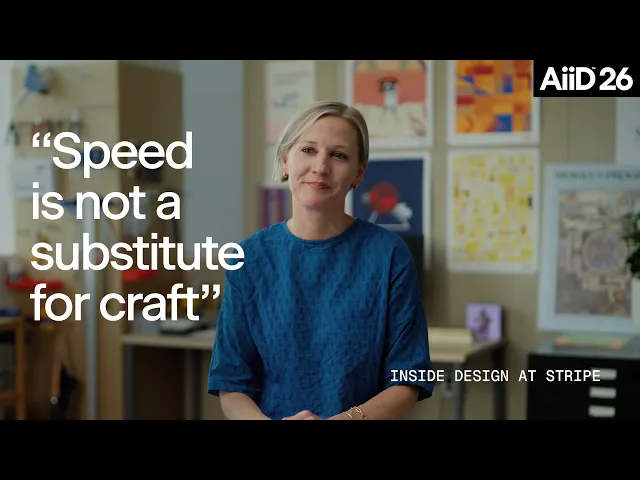
In our AI in Design case study series, we’re exploring how leading design teams are adapting their work for the AI era. Today, we’re looking inside Stripe, where experiments emerge from the bottom up and useful new workflows earn their way into wider use.
When Stripe’s Head of Design, Katie Dill, first encouraged her team to experiment with AI, the message was simple: go try the tools. At first, it didn’t lead to a ton of change.
Designers were busy and didn’t feel like they had room to take a risk on an unfamiliar workflow. They weren’t sure which tools were secure, whether they were allowed to use them, or who would pay for the subscriptions. It was a useful lesson: enthusiasm alone doesn’t drive experimentation. The organizational support around it matters just as much.
How do you create a culture of experimentation without prescribing exactly how people work?
Stripe changed its approach. It focused on clearing away practical roadblocks to adoption. It approved a broad set of tools, carved out dedicated time to explore, and made internal experiments visible across teams.
“We set the table to enable the party,” Katie says. “We try to make as many tools as possible available to teams, and the teams take it from there.”
That approach reflects a tension at the heart of how the company operates. Stripe aspires to become the world’s fastest company while simultaneously bringing craft and beauty to everything they make. The challenge is giving people room to experiment without locking into a process too early or mistaking fast output for finished work.
We spoke with Katie and members of Stripe’s design team, including product designers Ryan Spencer and Sadhika Billa, content designer Chris Greer, and Stripe Press designer Pablo Delcan, to understand how Stripe is approaching that balance.
What you’ll learn:
The importance of time, tool access, and peer visibility for effective AI use
How to turn useful experiments into repeatable ways of working
How Stripe moves quickly without mistaking fast output for finished work
Watch on YouTube • View the full case study
Make room to try things
Katie compares AI to the invention of the synthesizer. Before it existed, no composer would have written music that required someone to hit a piano key 50 times a second. The synthesizer didn’t just make music faster to produce; it made entirely new kinds of music possible.
She sees the same potential in AI: designers can explore more directions, turn them into reality sooner, and test ideas that once would have been too expensive to pursue. But first, they need time to learn the instrument.
Stripe focused on clearing three main hurdles that keep people from trying new things:
Dedicated time: Quarterly “AI-cation” days give designers clear permission to take a break from their day-to-day work to uplevel how they use AI. This includes testing out a new AI tool, prototyping an idea, or building a quick microtool to fix a personal pain point.
Frictionless access: Stripe pre-approves a wide range of software, and security clearances and expense approvals are handled upfront so no one’s stuck waiting on administrative red tape.
Visible experiments: Team demos, brown-bag lunches, and founder-led firesides give people regular opportunities to show what they’re working on.
Sharing is what turns a one-off experiment into something other people can use. Stripe maintains simple internal directories and leaderboards for custom agents and plugins, making it easy for anyone to find a tool, adapt it, and build on what works.
This kind of bottom-up discovery fits Stripe’s operating culture. The company hires high-agency people and gives them considerable freedom in how they solve problems. Designers belong to one central organization but work within specific product teams, leaving room for each group to develop an approach suited to its work.
Katie calls it working “more through carrots than sticks.” Leadership builds the environment, clears the administrative hurdles, and shows people what’s possible. What happens after that is up to the designers themselves.

Turn repeated friction into shared infrastructure
Once more people had room to experiment, they began fixing problems they encountered repeatedly.
ProtoDash grew out of a common issue in Stripe’s design reviews. People were using off-the-shelf AI tools to build fast prototypes, but the output often used the wrong fonts, invented non-existent components, and produced what the team called “blurple slop.”
Stripe already had a comprehensive design system called Sail. Owen Williams, a design manager, believed AI should build with those components instead of inventing rough approximations.
He created ProtoDash to bridge that gap. The first version combined Sail’s component library with a set of strict rules telling the AI model how to use them correctly. From there, Owen connected the tool directly to Stripe’s dev infrastructure, dropping the setup time to under two minutes. Later, he brought the tool into the browser as ProtoDash Studio, letting anyone generate, remix, and review live prototypes without ever touching a code editor.

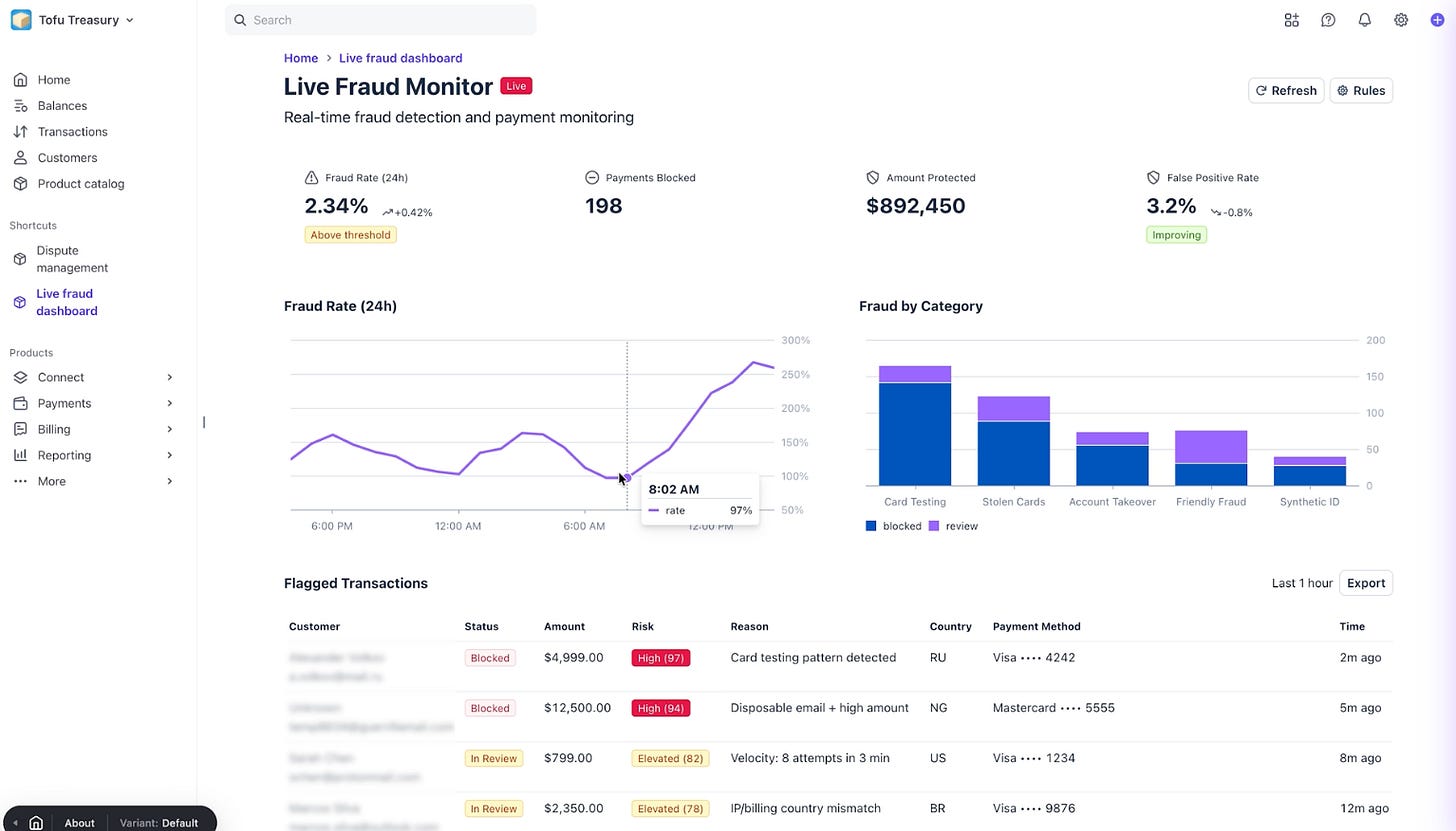
Product designers Ryan Spencer and Sadhika Billa recently used ProtoDash to explore concepts for a live fraud dashboard. Starting with a single prompt, they generated a fully interactive layout populated with realistic transaction risks, fraud rates, and blocked payment data. Instead of trying to explain the concept using static screens, they were able to put a working experience in front of users right away.
That accessibility has opened the tool to non-designers, too. Product managers are now among ProtoDash’s most active users, using it to test ideas with customers long before asking an engineer to write code.
In fact, the output is getting so sharp that on a recent Radar project, a ProtoDash prototype served as the primary source of truth for the engineering team – a first in Owen’s career as a design manager. And because anyone at Stripe can contribute back to the tool, ProtoDash keeps getting better with every project.
A separate internal tool called Dante addresses a different constraint: maintaining Stripe’s writing standards as the company produces two to three thousand new copy strings each day.
Stripe cares about details as small as sentence case, Oxford commas, and the difference between a hyphen and an en dash. But content designers could no longer review everything manually without becoming a bottleneck.
Content designer Chris Greer can drop a screenshot of a product screen into his terminal and ask Dante to review it. The tool flags headings written in title case, missing Oxford commas, or hyphens where standards call for an en dash. Because Dante works against live code, Chris can ask it to apply the fixes and submit the changes directly for engineering review.
“We don’t want to let the quality bar slip just because we’re shipping more and faster,” Chris says. “It became a question of designing a system to enable that at this newer scale.”
Katie describes the goal as helping people “fall into the pit of success.” Instead of relying on everyone to memorize every guideline, the system makes the right choice easy at the moment the work is being made.

Dante’s plugin changelog tracks new skills contributed by teams across Stripe, making shared content standards easier to discover and use.
ProtoDash and Dante address different problems, but they followed a similar path. Both began with someone close to the work fixing a recurring frustration. Once others found the result useful, Stripe gave the experiment a way to spread.
Take roof shots before moonshots
Allowing many experiments creates another question: when should one of them become the standard? Stripe has been deliberately slow to answer that question.
Katie describes the philosophy as taking “roof shots, not moonshots.” When generative AI first entered Stripe’s products, it was easy to imagine one universal experience that understood every customer. But too many fundamental questions remained unanswered.
Instead, teams started with small, focused projects. Radar added conversational tools for managing fraud rules. Docs brought natural-language search to developer guides. The Dashboard team tested its own approach with Stripe Sigma.
For a company known for coherence across its products, that comes with a temporary tradeoff: early experiments may not fit together perfectly. Katie thinks that tradeoff is worth it. Allowing each experience to develop independently gives the team time to understand what works in context so Stripe can bring the strongest ideas together once common patterns emerge.
Standardizing too early leaves an organization committed to yesterday’s workflow just as a better one arrives. Roof shots keep early decisions small and reversible while the team learns what deserves to scale.

Fast is not finished
The ability to make something look plausible in minutes creates an obvious temptation: mistaking a fast first draft for a finished design. Katie pictures AI-assisted creation as a tree growing wild. Ideas branch out faster than ever, but someone with taste, vision, and a distinct point of view still has to prune them into something coherent.
Pablo Delcan’s work for Stripe Press shows what that pruning looks like in practice. While designing the cover of The Scaling Era, he used AI to explore directions ranging from flowers shaped by neural networks to complex mathematical puzzles. The tools allowed the team to see whether a concept had potential before spending days making it real by hand.
“The concept still comes from us. The final cover is still made by us,” Pablo says. “AI just compressed the middle part of the process, the part where I used to spend days finding out whether an idea was worth the effort.”
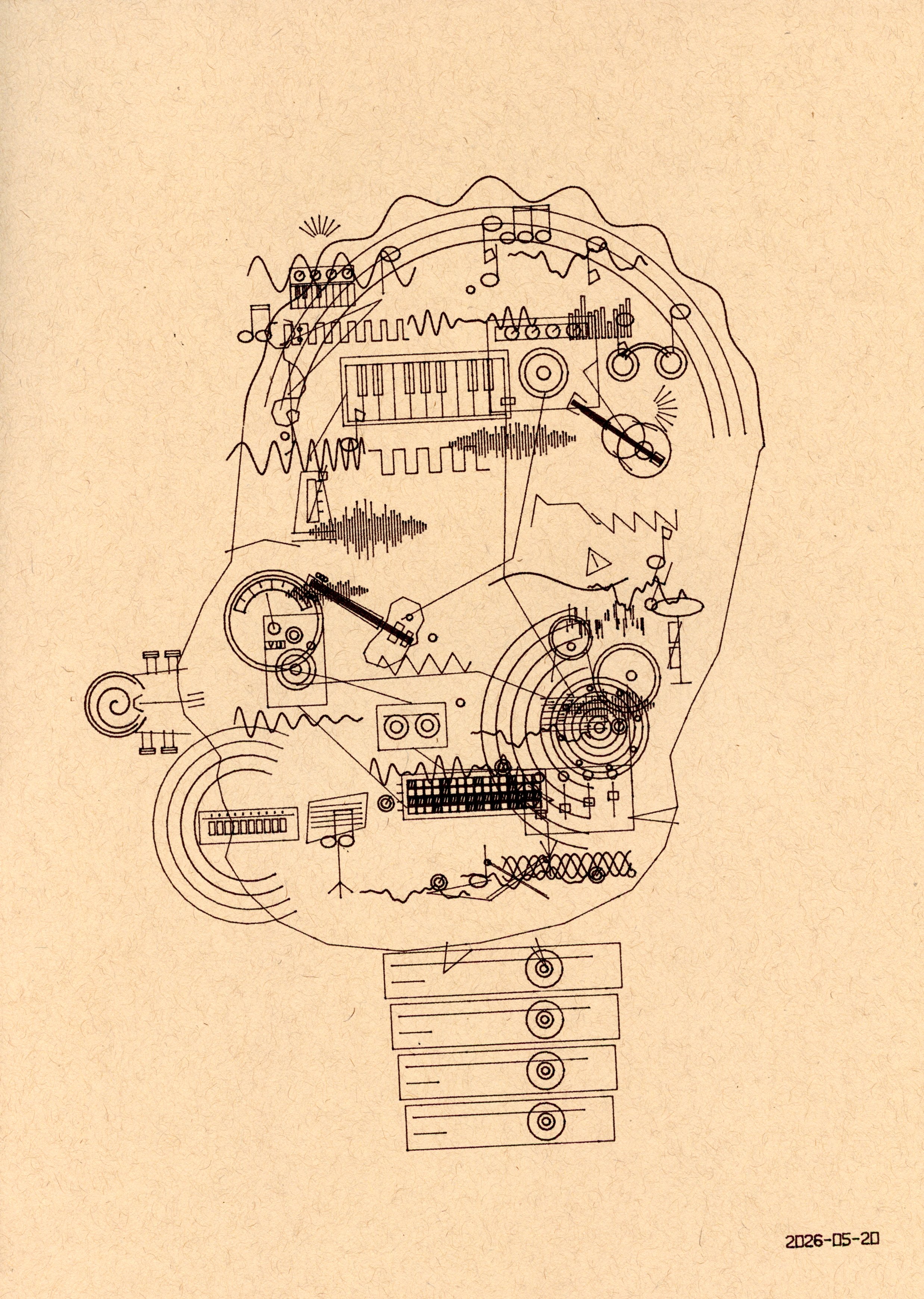
Pablo also uses these tools for open-ended experiments without an immediate application. In one project, he connected Echo, his OpenClaw agent, to a pen plotter and set it to draw throughout the day. The agent generated digital compositions; the plotter translated them into ink on paper.
The resulting drawings are strange, intricate, and unmistakably physical. They’re a clear example of the kind of exploration Stripe wants to make space for: not a top-down requirement or an efficiency play, but a designer finding out what happens when a new tool meets a physical medium.
The distinction between speed and finished work came up again when Katie used an AI-cation day to explore ideas for the Stripe Dashboard home screen. She fed a paper sketch into ProtoDash and had a functioning interface shell within minutes. The speed was impressive, but it also made the first result easy to overvalue.
Katie compares the feeling to microwaving a burrito for lunch. It’s ready in 90 seconds, which can feel like magic. It still isn’t a particularly good burrito.
Stripe’s teams apply this scrutiny to AI-generated imagery. An initial result might look convincing from a distance, but critiques still zoom in on light sources, shadows, and unnatural structures, what Katie calls a “maddening attention to detail.”
Her test for AI-generated work: “Would I be proud if it took me two weeks to get here?” If the answer is no, speed isn’t evidence that the work is done. It’s an invitation to keep going.
Leaders have to learn again
Historically, leadership experience compounded: those at the top had spent the most time doing the work, so they knew best how it should be done. Right now, a designer who joined last month might have discovered a tool their manager hasn’t even heard of.
“In some cases, I would recommend: don’t listen to the leaders,” Katie says. “They don’t necessarily know as much right now.”
Her advice to managers? Get back into the tools. Take the AI-cation day. Build a pet project or an internal utility. Work with the software long enough to feel what’s seamless and what’s still frustrating.
There is a practical circularity to Stripe’s approach. Leaders clear the path and create space. Designers use that freedom to build real solutions to daily friction. Stripe lets those tools prove their worth before making them standard, while leaders stay close enough to the work to recognize what deserves investment.
Setting the table is what makes the party possible.

Oct 6, 2026 | Designer Fund
When code is no longer the constraint: Inside Anthropic’s design team

Aug 24, 2026 | Designer Fund
How to grow as a designer when AI is changing everything: Inside design at Shopify

Aug 12, 2026 | Designer Fund
How tech’s most craft-obsessed team uses AI: Inside design at Linear

Aug 10, 2026 | Jackie Berardo