February 4, 2026
Designer Fund
Leif Abraham’s resume doesn’t read like a typical fintech founder’s. As a teenager in Germany, he taught himself design on a pirated copy of Photoshop. He spent his early career in agencies, pulling all-nighters for clients, building muscle memory around shipping under pressure. He tinkered constantly, co-creating viral hits like Pay with a Tweet and eventually founding And Co, a freelancer tool later acquired by Fiverr.
Public, the investing platform he now runs with co-founder Jannick Malling, grew out of that accumulation rather than a single moment of insight. The company reflects years of repetition: agency-derived discipline, running a startup that found product–market fit but didn’t quite become a breakout, and close observation of how internet-native users decide which products deserve their trust.
Public launched in 2019 with an ambitious goal: to become a serious, long-term home for self-directed investors instead of another speculative trading app. The company reached a $1.2B valuation in 2021 and now supports multi-asset investing across stocks, ETFs, crypto, bonds, options, and more.
For designer founders, Leif’s path will resonate because it’s shaped by iteration rather than inevitability. He’s been the agency designer, the freelancer, the operator of a scrappy SaaS product, and now the co-CEO of a scaled financial platform. Over time, that range led him to develop a set of practical filters—about customers, incentives, and personal fit—that now guide what he chooses to build.
In this conversation, we talk about:
How working at agencies helped develop execution habits that compounded later through building companies
How Public avoids the “next feature trap” by designing for belief vs novelty
The tradeoffs behind moving from “snackable” UI toward denser, more serious interfaces
The dinner table test: a simple way to evaluate whether a company and problem deserve years of your attention
Watch the interview on YouTube
Are you building something new, or know someone who is?
We’re always looking for more designer founders to feature, invest in, or partner with.
The early makings of a designer founder, found in the agency grind
Leif's years working at agencies shaped how he operates as a founder. Unlike product teams where deadlines can slip, agency work is unforgiving: the client shows up when they show up. If the work isn’t ready, you don’t renegotiate. You ship anyway. That helps build the type of discipline many founders only develop later, under far more pressure.
Agency work also forces a faster detachment from ideas. “You’re forced into experiencing your darlings die all the time,” Leif says. You learn to generate, test, and discard them without attachment.
There’s also a practical advantage for designers. Because they can build and test ideas themselves, they can fund early exploration through freelance work, buying time to learn before committing fully. “You can make something with your own hands and test it,” Leif says. “You don’t need to hire someone else to get started.”
Why building a great product isn’t good enough
And Co was a platform to help freelancers handle invoicing, contracts, payments, and the operational details of running an independent business. It emerged directly from Leif’s own experience doing client work and was built to solve problems he knew firsthand.
The product itself was thoughtfully designed and genuinely useful. The business, however, proved harder to scale: “It’s really tough to make that a large business,” Leif reflects, pointing to two fundamental constraints.
Distribution came first: “Performance marketing doesn’t really work for targeting freelancers.” Without a scalable acquisition channel, growth depended on partnerships and constant hustle.
Pricing sensitivity compounded the problem. “Any money they spend in a professional capacity for tools comes out of their own pocket.” At $20-30 per month, the business required massive scale to become meaningful—scale that was difficult to reach without solving distribution.
Looking back, Leif sees a deeper issue underneath both challenges: an imbalance between product craft and business mechanics.
How Public got started
After And Co, Leif knew he wanted to build something that could scale into a meaningful business and still reflect his values as a designer. Around the same time, his longtime friend Jannick Malling had also sold his company and moved to New York. They found themselves in a similar place, unexpectedly free to start something from scratch. Jannick began working on the idea for what would become Public, while Leif initially got involved as an investor while wrapping up his time at Fiverr.
The company launched in 2019 with a clear point of view on the investing landscape. Most platforms leaned heavily toward speculation, encouraging frequent trading and short-term behavior. Others focused on serving experienced investors, but at the cost of approachability.
Leif and Jannick saw an opportunity to build a serious financial service that felt modern and well-designed without sacrificing trust. For Public to play a meaningful role in how people build wealth, it needed to feel credible from day one. It had to be something people would trust with their life savings. This meant prioritizing credibility over clever features, and making sure that everything—from product decisions to how the company made money—focused on trust, incentives, and long-term alignment.

The case for seriousness in designing for fintech
In early 2022, Public made a decision Leif points to as a turning point. Inside the company, it became known as “level up”—a deliberate shift in ambition and audience, framed as a long-term bet. Leadership warned the team not to expect immediate payoff; the strategy was built on patience, with a two-year horizon before it would register cleanly in the metrics.
Rather than trying to be a platform for everyone, the company decided to narrow in on the top quartile of digital natives: people with enough financial fluency to care about fundamentals, enough conviction to invest for the long haul, and enough engagement to track markets beyond headlines.
The shift in strategy quickly surfaced in the UI. Leif frames the design problem as a balancing act: bring more sophistication into the experience without making it feel complex, and avoid “simplicity” that reads as lightweight or unserious. In practice, that pushed Public toward a more information-dense interface and a more restrained visual language:
More data per screen (depth over snackability)
Tighter typography (less emphasis on big, bold numbers)
A stronger desktop experience, reflecting how committed investors prefer to manage money

If the shift looked “less pretty” in places, it was by design. Public’s internal rule (“UX over UI”) puts reliability ahead of polish. In a brokerage, trust is built through mechanics: whether the app stays up, whether customer support responds, whether workflows behave consistently, whether a trade confirms quickly, and whether the user understands exactly what just happened.
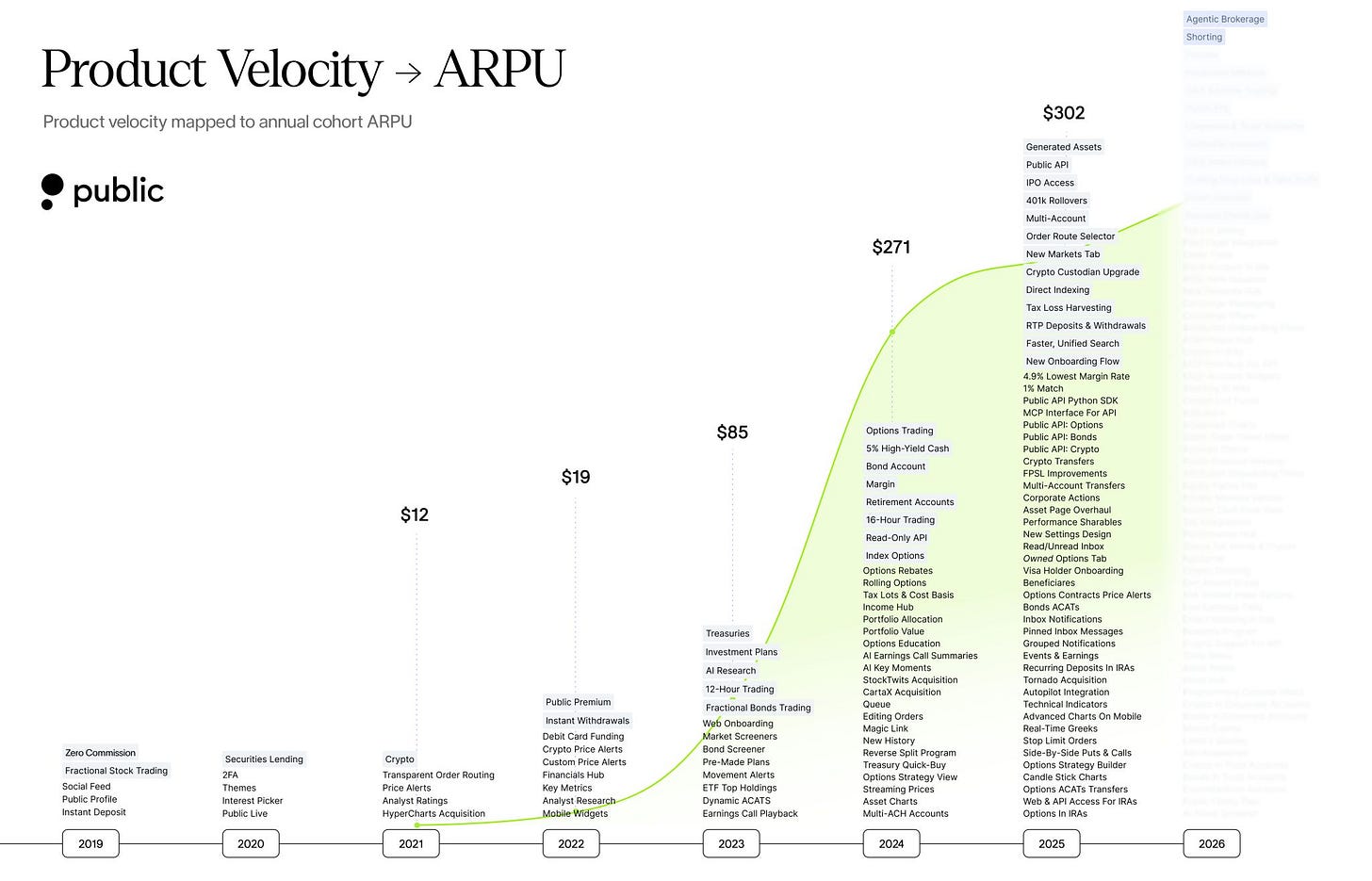
Public pairs that reliability with an unusually fast shipping cadence. Internally, they treat product velocity as a leading indicator of health. In 2025, the team shipped roughly one major new feature or product each week without increasing the size of its engineering organization year over year. They’ll continue to do that and more this year.
Turning users into advocates through emotional retention
Leif describes two different forces that keep customers loyal: utilitarian retention and emotional retention.
Utilitarian retention is straightforward. People stay because the product works, the fee is competitive, and the features are solid. Those are all important, but easy targets for competitors to attack. Someone can undercut pricing. Someone else can copy functionality. That dynamic creates what Leif calls the “next feature trap”: the belief that this next release will finally unlock durable growth. When it doesn’t, the cycle repeats.
Emotional retention means customers stay because they feel aligned with how the company behaves: how it treats users, how it makes money, and what it refuses to do. This kind of attachment is much harder to replicate.
He gives this example:
“If we meet each other at a bar and you pull out the other green app, my reaction shouldn’t be, ‘I like Public more because they give me a higher interest rate.’ It should be: ‘Whoa, whoa, what are you doing on there, Ben? You need to be on Public.’”
That emotional (and perhaps even irrational) reaction is what Leif believes separates products people tolerate from products people defend: “When someone sticks with you because they’re a believer, not just because of a feature, you suddenly get things like pricing leverage. And that’s also the best kind of marketing—when customers feel such a strong emotional connection to the company that it feels personal to them and suddenly they become advocates, rallying on your behalf.”
That shift from user to advocate is what allows a company to make harder, longer-term decisions without immediately losing its base. After the GameStop surge in early 2021, the company stepped away from payment for order flow for equities trades, a meaningful short-term revenue trade-off in favor of cleaner long-term incentives.
More recently, they ran a Wall Street Journal ad stating:
“Wealth is not won in a bet. If you’re looking for a broker that’s not also your bookie, we invite you to try Public.”

The dinner table test
Leif uses a simple mental model to assess whether he’s building the right company: Would I genuinely want to sit at a dinner table with my customers and enjoy the conversation?
When he asked himself that question about And Co, the answer wasn’t a clear yes. The imagined dinner conversation centered on late invoices and difficult clients; important problems, but not topics he personally felt energized by.
Public feels vastly different. “Now I sit there and nerd out about the markets,” he says. That contrast connects directly to another principle he holds tightly: being a power user of your own product. With Public, Leif actively invests, tracks markets, and uses the product the same way many of the company’s most engaged users do. That creates a tight feedback loop between what he experiences personally and what gets built.
What Public is building towards
Public’s next chapter builds directly on the principles that shaped its earlier decisions. Rather than treating AI as a novelty, the company is using it as core infrastructure by reducing friction, increasing clarity, and supporting more deliberate decision-making for self-directed investors.
Over the past year, Public has rolled out tools that let investors build and adjust portfolios using natural language. Users can create custom portfolios—effectively their own indexes—that live alongside traditional ETFs, without navigating multiple screens or products.
What comes next pushes further in the same direction. In 2026, Public plans to introduce agentic brokerage: user-approved automation for things like moving idle cash, rebalancing positions, or setting rules around risk. The system doesn’t act on its own. Investors decide the rules, and the software carries them out.
The arc is straightforward. Public is building for people who want to stay involved in their decisions while removing the busywork around them, shipping at a pace that compounds over time without chasing novelty. For Leif, that combination—agency discipline, user alignment, and a problem that passes the dinner table test—represents everything he learned from the long accumulation that brought him here.

Oct 6, 2026 | Designer Fund
When code is no longer the constraint: Inside Anthropic’s design team

Sep 15, 2026 | Designer Fund
How Stripe creates room for good ideas to spread

Aug 24, 2026 | Designer Fund
How to grow as a designer when AI is changing everything: Inside design at Shopify

Aug 12, 2026 | Designer Fund