
May 20, 2026
Robyn Park
One of the narratives around AI and design in tech is that designers are getting squeezed out—that as software becomes easier for anyone to build, designers matter less.
The data we’ve uncovered in our second annual AI in Design report points to a more nuanced shift. Designers are owning more and shipping more. But they’ve also gone up a layer of abstraction to become builders. They’re not just producing deliverables—they’re spinning up new design tools to produce them. They’re inventing systems that help their companies harness more creative potential of non-designers and designers alike.
We believe this is the start of a foundational shift in how work gets done and how companies see their people. And it’s happening fast. In the year since our 2025 report, weekly AI usage for design tasks has jumped from 54% to 91%, and 75% use it daily. But the most significant changes have been qualitative. Last year was about early experimentation. Now, AI has spread into all parts of the design process—and brought designers into areas that most didn’t touch, like coding, prototyping, and accessing business data at scale to influence decisions.
We explore these themes and more in AI in Design 2026, created by Designer Fund and Foundation Capital. The report draws on a survey of more than 900 designers across 60+ countries, 25+ in-depth interviews, and case studies with the design teams at Anthropic, Framer, Linear, Notion, Shopify, Sierra, and Stripe. Each video goes inside their workflows, the tradeoffs they’re navigating, and how they’re operating differently now. If you’d like to be notified as they’re released, sign up here.
For design leaders wondering how others are running their teams, we want to shine a light and help you ask the right questions for the path ahead. For designers, we share what advanced builders are creating and what managers are looking for in candidates now.
And even as we surfaced patterns, we found that attitudes and behaviors vary widely by company and by individual. Depending on where you sit in the industry, these findings may feel surprising, validating, or somewhere in between. Our goal with this research is to bring more clarity to a conversation that’s evolving incredibly quickly.
Below are a few findings from the full report that we want to highlight. You can also read Fast Company's coverage of the research.
Designers are becoming builders
Half of the designers we surveyed—across product and brand design, not just design engineers—said they’ve shipped AI-generated code to production.
We’re now moving from “should designers code” to “when and how should designers code?” AI tools are lowering the barrier for designers to prototype, build, and ship ideas themselves.
One of the more surprising findings was that leaders and managers are shipping code as much as (and sometimes more than!) individual contributors. Many described using AI tools to quickly prototype ideas, test workflows, or move projects forward without waiting on engineering bandwidth.
We also saw continued movement away from static deliverables. Prototypes are becoming a more central design output, and in some teams they’re replacing mockups altogether.
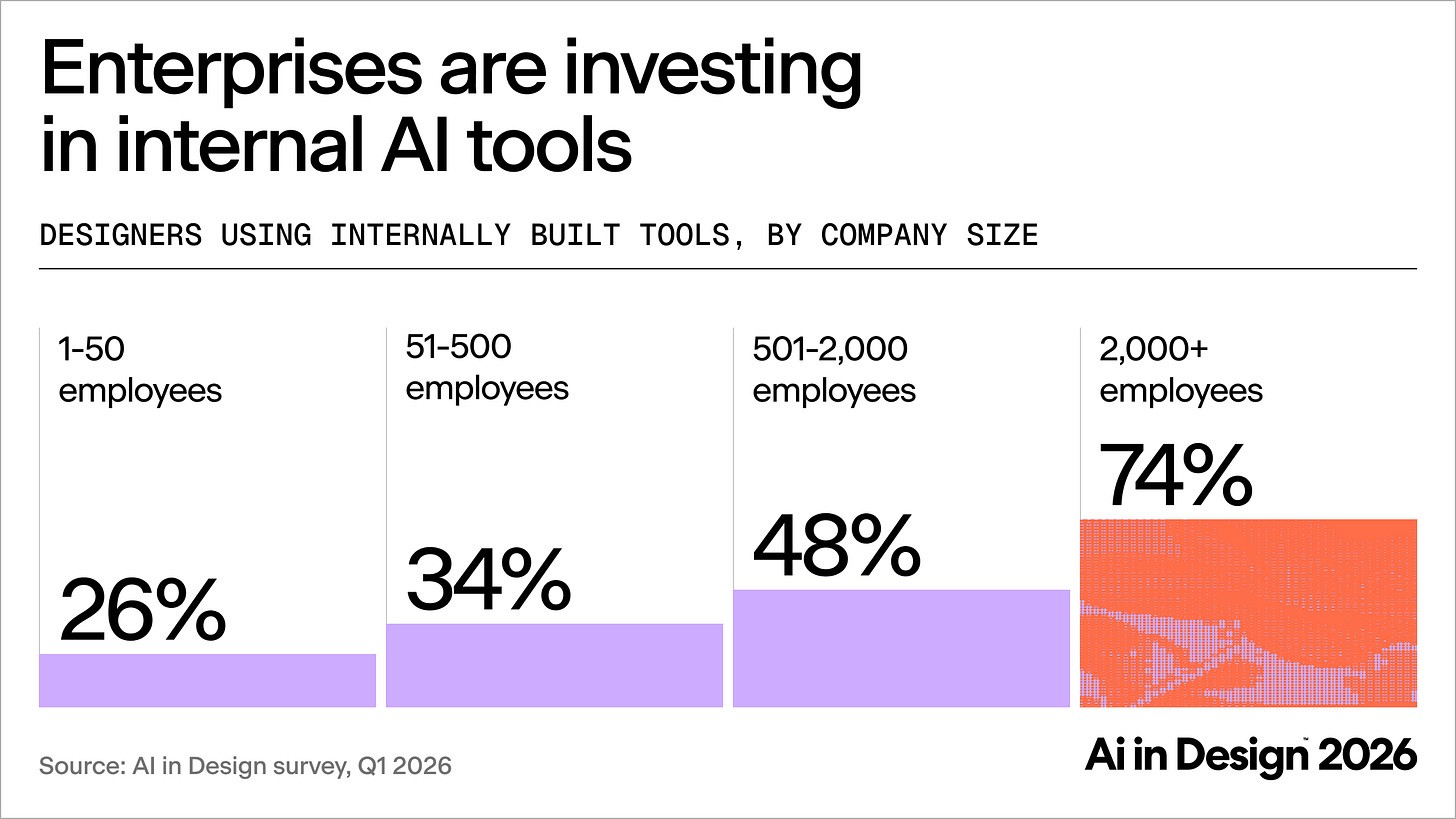
And more designers, especially at enterprise companies, are building their own custom tools. They’re inventing microtools to automate manual work, creating the design software they’ve always wished they had, and orchestrating agentic workflows that let non-designer teammates create on-brand work using prebuilt design system components.
The toolstack is expanding and fragmenting
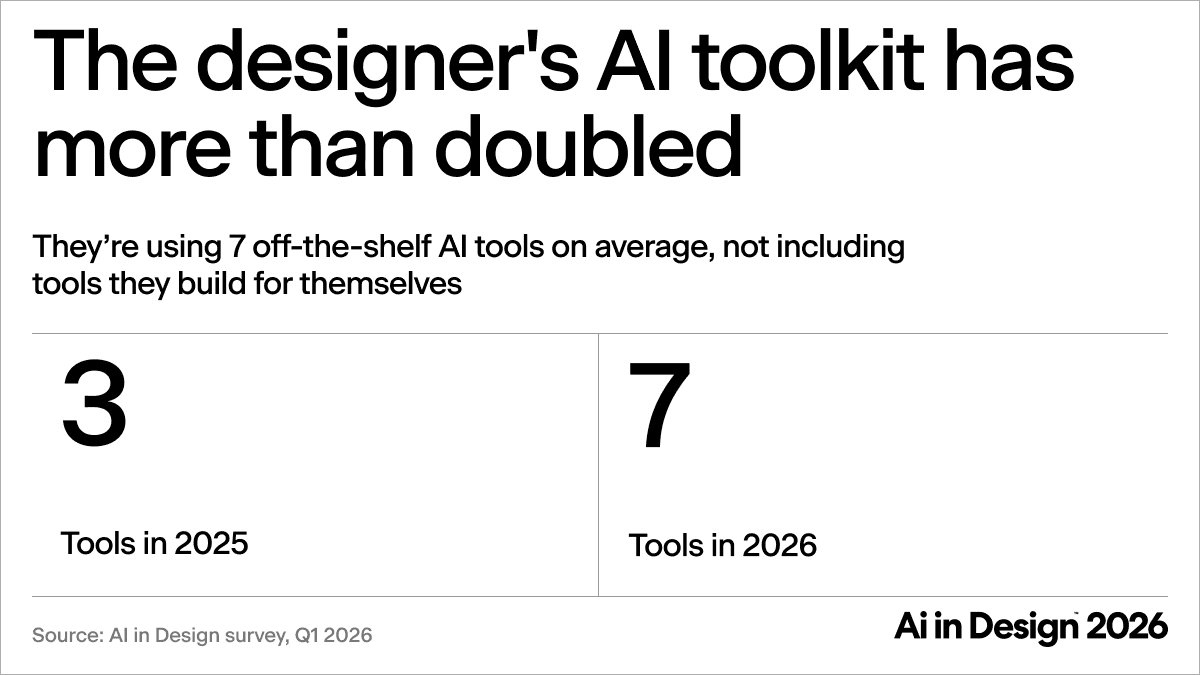
The average designer in our survey now uses 7 off-the-shelf AI tools regularly, more than double last year’s average of 3. That doesn’t include the internal tools many teams are building themselves.
Rather than converging around a single “standard” workflow, design stacks are becoming more personalized and fluid. Teams are stitching together different models, prototyping tools, and coding environments depending on the task and how they like to work.
When we asked what challenges designers face when using AI in their workflow, the most common answer was “unreliable output quality.” Output quality is also the single most important factor in whether an AI tool becomes part of a designer’s regular workflow.
Roles are continuing to merge
65% of designers said they’re taking on more product or engineering responsibilities, while 40% said the reverse is also happening: PMs and engineers are contributing more to design work. As designers move closer to code and prototyping, traditional role boundaries are continuing to blur, with product development becoming more shared across disciplines.
But that increase in overlap doesn’t always translate to closer collaboration, both within design teams and across product orgs. Last year, only 5% of respondents said collaboration had decreased because of AI. This year, that number rose 4x to 20%.
Several designers described a shift toward more solo work: spending more time in prompting and in terminals, and less time in live back-and-forth with teammates. Work is moving faster, but some of the connective tissue of collaboration hasn’t kept pace.
What design leaders are hiring for
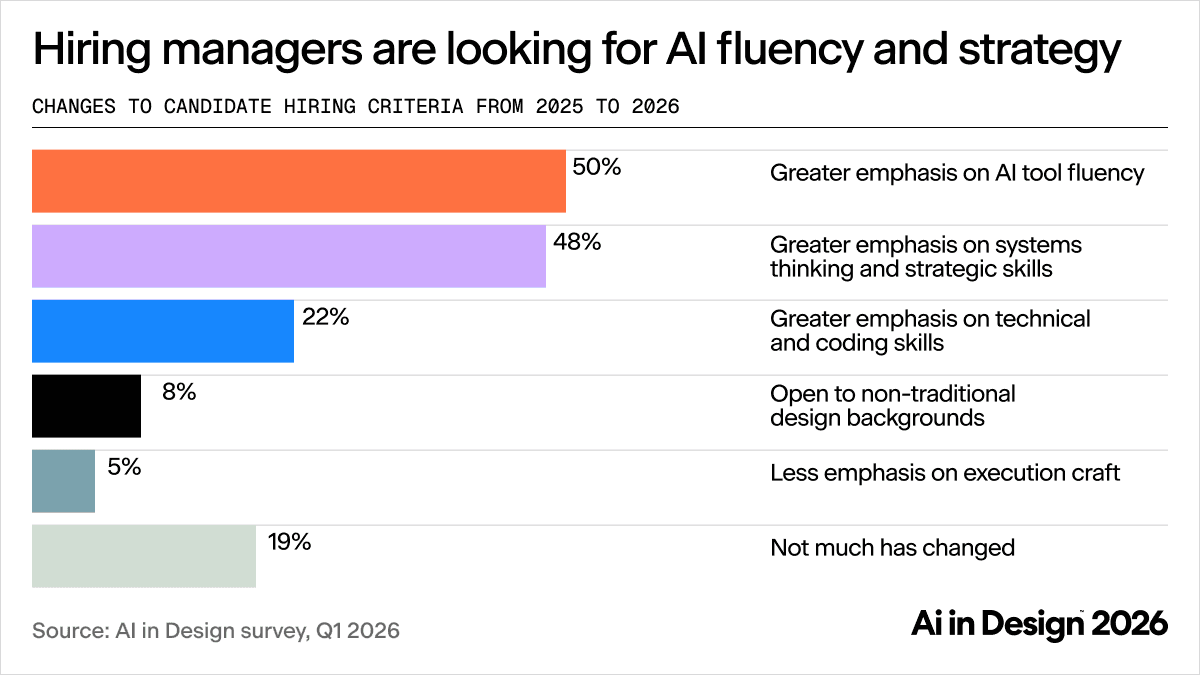
50% of the leaders we surveyed said they’re placing greater emphasis on AI fluency when hiring, followed closely by systems thinking and strategic skills. Compared to a few years ago, there’s less focus on narrow specialization and more demand for designers who can navigate ambiguity, connect disciplines, and shape direction.
Part of that shift comes from how AI is changing the design process. As tools become more integrated into product development, designers are increasingly expected to operate across the full arc of creation, moving from strategy to prototyping to execution with more fluidity. Several leaders described designers as “orchestrators”: people who can guide workflows and translate ideas into outcomes.
At the same time, stronger tools haven’t lowered the bar for quality. Only 5% of leaders surveyed said they’re placing less emphasis on execution quality. If anything, many argued that taste, judgment, and the ability to uphold a high standard matter even more now that AI makes it easier for anyone to generate “good enough” outputs.
Expectations are changing faster than company policy
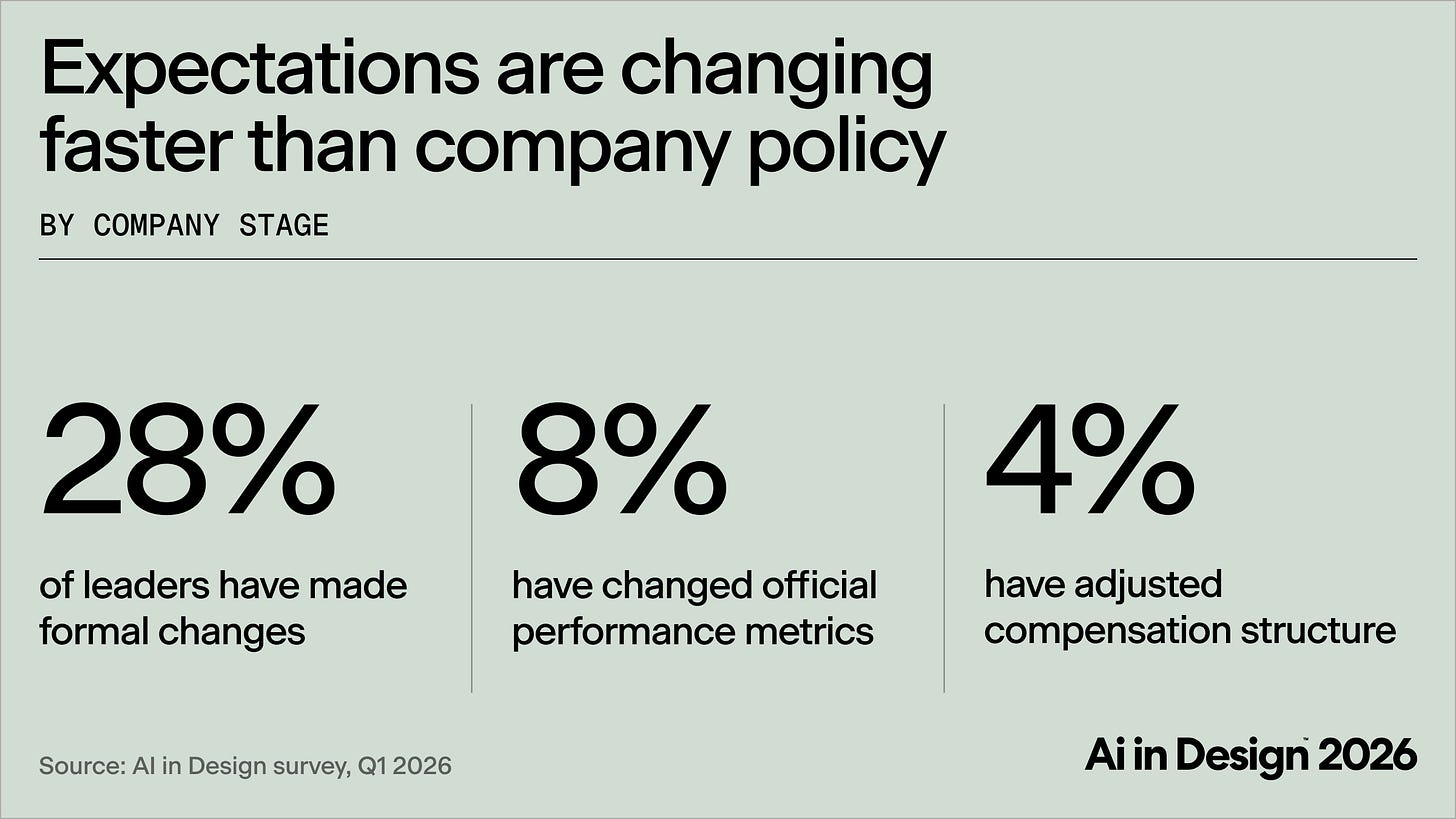
73% of designers say they feel rising expectations around output, quality, and speed. Yet only 28% of leaders say their companies have made formal updates to evaluation, comp, or hiring. Just 8% have changed performance metrics, and only 4% have adjusted compensation structure.
Learning is still happening bottom-up: peer learning more than tripled year over year (from 24% to 80%), while taking recommendations from leadership dropped from 32% to 16%. Designers are figuring this out from each other vs from above.
The teams pulling ahead are the ones whose leaders accept that and build for it—creating conditions for tinkering, spotlighting employee-built tools in company forums, running hackathons, and protecting space to share workflows. This directly translates to employee satisfaction: Designers at companies with a culture of tinkering are 2x more likely to say they feel more creative and capable, even though they also face a higher bar.
Where this leaves designers
We believe it’s critically important that designers remain part of building software. Designers bring something unique to the table: user empathy, taste, an inherent sense of what to build and what not to build, delight, and the discipline to care about positive outcomes rather than just more software. As AI makes it easier for anyone to produce interfaces, that judgment becomes more valuable, not less.
Whether you’re a design leader making decisions on tooling and hiring, a designer thinking about how your craft should evolve, a founder trying to understand how AI is changing the way design gets done, or a student preparing for what’s next—we hope this report gives you something useful to work with.
We’d love to hear what you think.
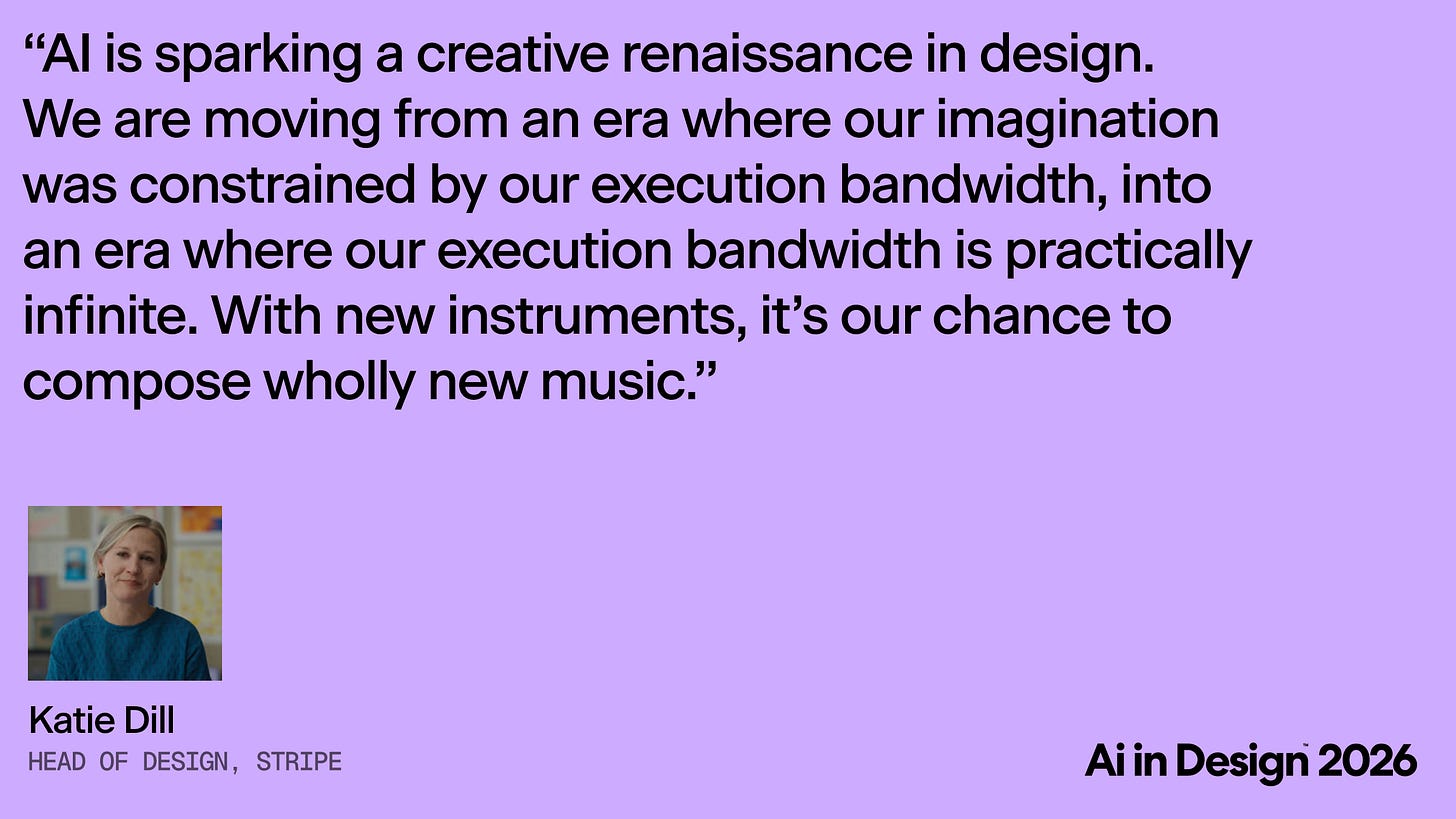
We’re also publishing a series of case studies alongside it, with teams at the forefront of this shift: Anthropic, Framer, Linear, Notion, Shopify, Sierra, and Stripe. Each one looks at how a team is navigating these changes in practice. Sign up here to get them as they’re released.
AI in Design 2026 is a research project by Designer Fund and Foundation Capital. We co-produced this report to better understand how AI is reshaping design, product development, and the people who build software. If you're a founder, designer, or researcher working on something we should know about, please reach out to hello@designerfund.com.
Oct 6, 2026 | Designer Fund
When code is no longer the constraint: Inside Anthropic’s design team

Sep 15, 2026 | Designer Fund
How Stripe creates room for good ideas to spread

Aug 24, 2026 | Designer Fund
How to grow as a designer when AI is changing everything: Inside design at Shopify

Aug 12, 2026 | Designer Fund